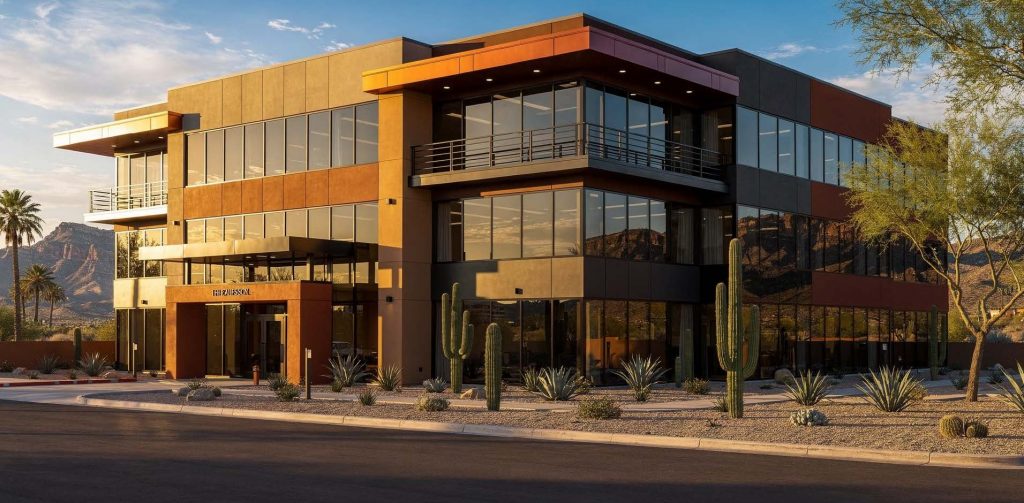
The Tucson office market is heading into 2026 as a “steady but selective” environment: post-COVID damage has largely been absorbed, but hybrid work and cautious tenants will keep conditions competitive and tenant-favourable in many Southern Arizona submarkets. Against that backdrop, Southern Arizona’s cost advantage and growing employment base still create clear opportunities for tenants, owner-users, and investors who approach the market strategically.
Post-COVID Demand and Vacancy
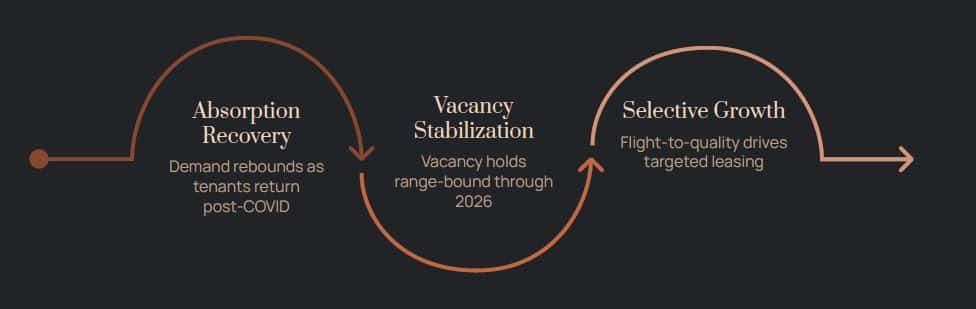
Hybrid work, space rightsizing, and longer decision cycles continue to shape how the post-COVID workforce uses office space across Southern Arizona. Net absorption has flipped from the sharp losses seen earlier in the cycle to modest positive or flat quarters, which has kept vacancy in a roughly 9-11% band rather than spiking higher.
Tenant Priorities
Tenants remain cautious, prioritizing flexibility, shorter initial terms, and rights to expand or contract as headcount evolves.
Market Conditions
Vacancy is no longer rising rapidly, but it is still above pre-pandemic lows, leaving most non-trophy and older assets squarely in tenant-favourable territory.

Construction Pipeline and Space Quality
A very limited construction pipeline is one of Tucson’s key stabilizers heading into 2026. High construction costs, tighter financing, and softer performance for office have effectively capped new speculative projects.
Supply Constraints
No major multi-tenant office projects have broken ground in recent years, keeping new supply in check and helping vacancy “move sideways” instead of surging.
Quality Gap
The gap between best-in-class buildings and older, undifferentiated products is widening; modern systems, parking, and medical-ready or flexible layouts are winning most of the tours.
Rental Rates and Tucson’s Cost Advantage
Even with national office headwinds, Tucson’s asking office rents have shown slow but positive growth, with full-service averages in the mid-$20s per square foot and select Class A and Foothills product reaching around $30/SF. That positions Tucson at a discount to Phoenix and well below coastal markets, which continues to attract value-driven occupiers.
$25
Average Full-Service Rent
Per square foot across the Tucson office market
$30
Class A Premium
Foothills and top-tier properties
Year-over-year rent growth has been modestly positive, outperforming many larger metropolitan areas where face rents have flattened or declined.
Rising TI and build-out costs-often 30-40% higher than just a few years ago-are pressuring effective economics and pushing landlords toward higher concessions instead of deep rent cuts.
Medical Office: The Strongest Segment
Healthcare and medical offices remain the strongest slice of the office market, both on the leasing and investment sides. Medical-oriented buildings and campus-adjacent assets continue to capture a disproportionate share of absorption and sales volume.
Major Tucson health systems are actively leasing significant blocks of space for cancer care, specialty clinics, and outpatient services, helping to anchor key medical corridors.
Owner-Users and Long-Term Drivers
Large-scale industrial and advanced manufacturing investment, such as American Battery Factory’s gigafactory near Tucson International Airport and continued Raytheon growth, bolster the regional employment base and support long-term office demand for professional, engineering, and support functions.

Manufacturing Growth
American Battery Factory gigafactory driving employment

Defense Sector
Raytheon expansion supporting professional services

Healthcare Systems
Major health systems are anchoring key corridors.
2026 Market Outlook
2026 is shaping up as a stabilization year: vacancy is expected to remain range-bound, modest rent growth should continue, and “flight-to-quality” will favour medical, well-capitalized, and best-in-class assets across Southern Arizona. Tenants and owner-users who act early, underwrite carefully, and leverage competition among landlords will be best positioned.
Tenant Strategies for 2026
Tenants should press for robust TI packages or turnkey delivery, free rent or phased rent commencement, and expense protections, while keeping a close eye on sublease options and adaptive-reuse opportunities in older stock.
1 Negotiate TI Packages
Secure robust tenant improvement allowances or turnkey delivery to offset rising buildout costs
2 Maximize Concessions
Push for free rent, phased rent commencement, and expense protections in tenant favorable market
3 Explore Alternatives
Consider sublease options and adaptive reuse opportunities in older stock for additional savings
4 Build in Flexibility
Secure rights to expand or contract space as headcount evolves with hybrid work models
Owner-User and Investor Opportunities
Cost Advantage
Owner-users and private investors can still secure attractive long-term economics in Tucson relative to Phoenix and coastal markets, especially when pricing, functionality, and long-term control align with business needs.

Pricing Advantage
Tucson office assets are priced below Phoenix and significantly below coastal markets
Long-Term Control
Owner user opportunities provide stability and control over operating expenses
Medical Focus
Medical office and campus adjacent properties offer the strongest investment fundamentals
Take Action on Your 2026 Strategy
To tailor these trends to your 2026 strategy in Southern Arizona—whether you are leasing, buying as an owner-user, or repositioning an office or medical asset—contact Commercial Real Estate Group of Tucson, LLC at Michael@cretucson.com or 520-299-3400 for a focused, property-specific plan.
Share your experiences on working with Commercial Real Estate Group of Tucson.